

Filter

Location
- Miami, USA
Job Type
- Road / Warehouse Based
Filter
Location
- New York, USA
Categories
- Notice
- Pinned
Monday 12th October 2026
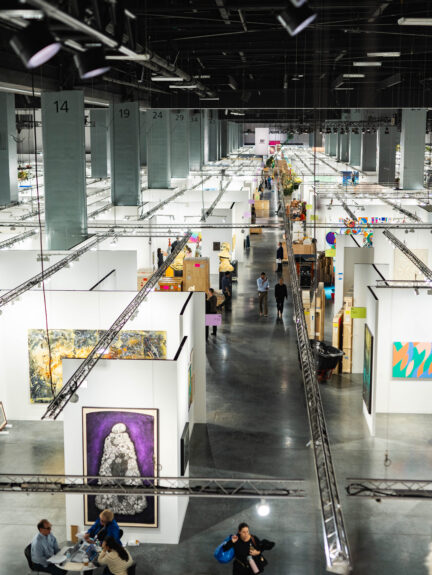
Art Basel Miami
MOVING MASTERPIECES
The Invisible Infrastructure Behind the Global Art Market
Oliver Howell and Paul Cannon, CEOs of Gander & White Europe and USA respectively, explore the invisible infrastructure behind the international art market and why experience, adaptability and trust remain essential in an increasingly complex world.
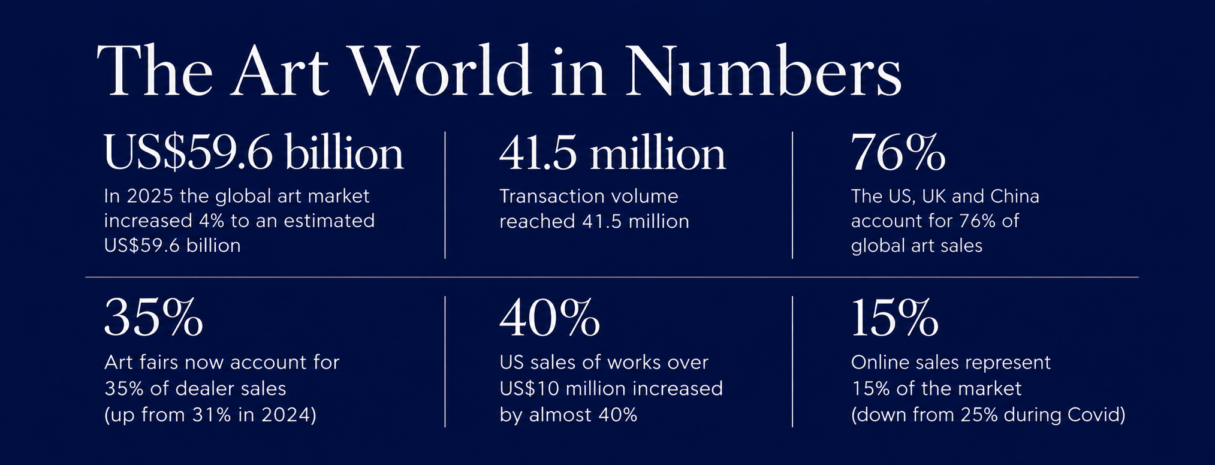
The Art World in Numbers
When people stand in front of a masterpiece, they rarely think about how it got there. Nor should they.
Whether it is a Vermeer hanging in a museum, a sculpture unveiled at an international art fair or a private collection assembled over generations, the focus should always be on the object itself, not the journey.
The finest logistics are almost invisible. Months of planning, specialist packing, conservation advice, customs expertise, security protocols and meticulous coordination disappear entirely. Success, in our profession, is often measured by what nobody notices.
Yet behind every major exhibition, every museum loan, every auction, every art fair and every private collection sits an invisible infrastructure that enables culture to move.
The art world rightly celebrates artists, collectors, curators and record-breaking sales. It talks far less about the expertise required to ensure that culturally significant objects travel safely between continents, institutions and generations. Without that expertise, the global art market simply would not function.
For more than ninety years, that has been Gander & White’s role. Not to be seen, but to make everything possible.
The biggest misconception about fine art logistics
People often assume that fine art logistics is about merely moving objects from A to B. It isn’t, at least, not in the way most people imagine.
The real work begins long before a crate is built or a vehicle leaves one of our fine art storage facilities. It starts with understanding the object itself.
A Renaissance panel painting behaves differently to a contemporary art installation. A monumental bronze sculpture presents different challenges to a fragile manuscript. Every material responds differently to movement, vibration, temperature and humidity. Every lender has different requirements. Every destination has its own regulatory framework. Each territory its own customs regulations. Every project carries its own risks.
Then there are the layers of expertise that most people never see: conservation, customs, insurance, security, installation, environmental management, and risk assessment. The relationships built over decades with museums, registrars, galleries, customs authorities and institutions around the world.
Every journey is different and every project requires judgement. That is why fine art logistics has never simply been about transportation. It has always been about stewardship.
At Gander & White, we often describe ourselves as temporary custodians. For a brief period, some of the world’s most important cultural objects are entrusted to our care. That responsibility shapes every decision we make.
90 years of adapting
Gander & White was founded in October 1933. Less than six years later, Europe was at war.
For a young business dedicated to moving valuable objects internationally, it would have been difficult to imagine a greater disruption.
Over the following decades we navigated post-war reconstruction, changing governments, oil crises, the emergence of new collecting centres, the opening of international markets, the end of the Cold War, Brexit, a global pandemic, sanctions, tariff disputes and rapidly evolving collector expectations and tastes.
Along the way, we have been entrusted with some of the world’s most significant cultural movements.
From transporting King Faisal’s personal collection following his assassination, to moving the iconic Ashes trophy from Lord’s to the V&A – only the third time it had ever left the cricket ground – our history is punctuated by extraordinary objects and often extraordinary circumstances. In the 1990s, we navigated the considerable diplomatic complexities involved in bringing the Stuart Silver Collection from Moscow to London; we have overseen the journey of works from the Royal Collection to many global destinations including France and the US; and more recently we stored and reinstalled the National Portrait Gallery’s collection during its three-year refurbishment, and we were appointed official shipping partner for the last edition of the RED auction during Art Basel Miami, responsible for the safe carriage of works by Jeff Koons, Ai Weiwei, Christo and Frank Gehry.
Gander & White has worked behind the scenes to help museums, galleries, auction houses and private collectors realise some of their most ambitious projects. In many ways, our own history mirrors the changing shape of the international art market itself: increasingly global, increasingly ambitious and, inevitably, increasingly complex.
Those experiences have taught us one simple lesson. The art world has never stood still, and neither have we.
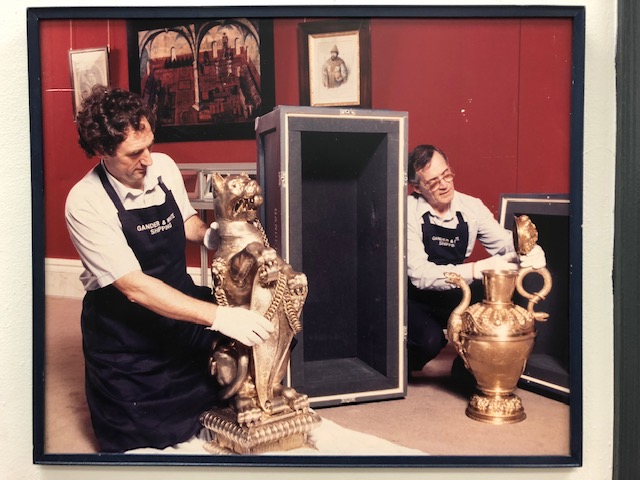
Gander & White Techs installing The Kremlin Stuart Silver collection for an exhibition in the Early 1990s.
Complexity isn’t new. The pace of change is.
One of the phrases we hear most often today is that moving art has become more complicated than ever before. There is some truth in that.
The movement of culturally significant objects has always demanded specialist expertise.
International exhibitions have always depended upon meticulous planning. Customs procedures have always required specialist knowledge. Political events have always influenced how and where works of art travel. Certainly fine art logistics has never been straightforward.
What has changed is the pace at which those challenges evolve.
Brexit introduced a new layer of complexity to movements between the UK and Europe. At Gander & White, we estimate that the additional customs requirements have increased administration time for these shipments by around 20%. Before Brexit, anything that did not require an export licence or CITES permit could move relatively seamlessly within the EU. Today, every individual item requires customs clearance and its own commodity code. For a large interior design project, that can mean cataloguing everything from a four-poster bed to a toothbrush holder. A useful illustration of how seemingly straightforward movements have become considerably more complex.
Almost as soon as businesses had adapted to Brexit and recovered from the pandemic, changing tariff discussions began reshaping other international markets. Conflict in the Middle East affected global shipping routes. Wildfires in California highlighted the importance of resilient storage strategies and contingency planning.
At the same time, collectors increasingly expect real-time visibility, museums face growing sustainability expectations and regulations continue to evolve.
Each challenge demands a different response. And each becomes another chapter in a profession built on adapting to change.
A resilient global market
According to the 2026 Art Basel and UBS report, the global art market is worth approximately $59.6 billion, demonstrating remarkable resilience. International fairs continue to attract hundreds of thousands of visitors every year. Museums collaborate across continents on increasingly ambitious exhibitions – just look at the British Museum’s collaboration with the Bayeaux Tapestry, an extraordinary logistical feat that is not without controversy. Collectors remain more international than ever, building collections that span multiple countries and cultures.
The appetite for cultural exchange has not diminished, if anything, it has strengthened.
Rather than signalling a market in decline, the evidence suggests something more nuanced. The art market is adapting to a new economic and geopolitical reality. Business models are evolving, collecting habits continue to shift and organisations across the sector are refining how they operate, but the fundamentals remain remarkably resilient. What continues to evolve is the expertise required to support it.
Behind every successful exhibition or international transaction sits an intricate network of specialists quietly ensuring that culture can continue to move safely around the world.
Experience has become one of the market’s greatest assets
Every generation believes its challenges are unprecedented – history usually proves otherwise. Experience does not provide all the answers, but it does offer perspective.
It teaches you which challenges represent genuine structural change and which are simply today’s version of problems the industry has successfully navigated before.
It tells you which relationships matter, where preparation matters, where patience matters, and where decisive action matters. In today’s world, the consequences of getting those judgements wrong are perhaps greater than they once were.
A delayed shipment can postpone a museum exhibition opening. An overlooked customs requirement can disrupt an international loan. A poorly planned installation can affect years of curatorial preparation.
The art world has not become more fragile, but it has become less forgiving of mistakes and that makes experience more valuable than ever.
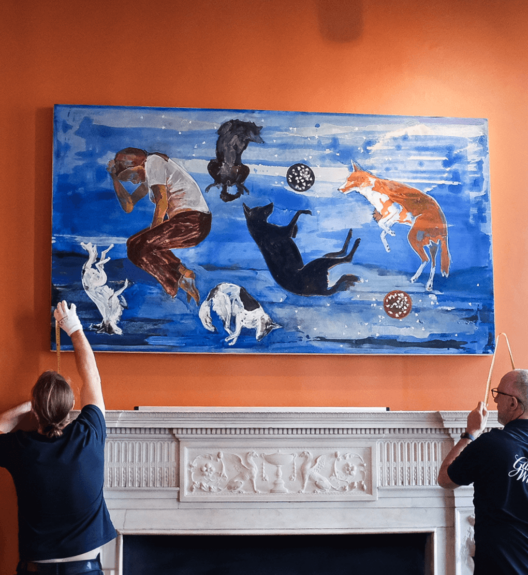
An Installation at The Dover Street Arts Club
Technology will change. Trust won’t.
One of the biggest transformations to the logistics industry is the ever-evolving technology. Environmental monitoring provides unprecedented visibility. Digital documentation has streamlined processes. Clients rightly expect greater transparency and more frequent communication than ever before.
These developments have made the movement of art safer, smarter and more efficient. Yet however advanced technology becomes, it does not replace judgement.
It cannot reassure a museum director lending an irreplaceable masterpiece overseas. It cannot anticipate how a geopolitical event might affect a carefully planned route. It cannot build the trust that underpins decades-long relationships with institutions and collectors.
Technology will continue to evolve, but trust will matter even more.
We don’t simply move art.
At Gander & White we don’t just move art, we enable culture and that distinction matters. Every object entrusted to us carries more than financial value. It carries history, scholarship and identity. At times national significance, at others profound personal meaning.
For a brief period, those objects become our responsibility, not as owners, but as custodians.
For nearly a century, that responsibility has remained unchanged in our business, even as the world around us has transformed.
The next decade will undoubtedly bring new challenges: new markets, new regulations, new technologies, and new geopolitical realities. History tells us that change is inevitable.
What should never change is the care with which we protect the world’s cultural heritage. Because while masterpieces belong to history, their journeys depend upon the people entrusted to look after them.
That has been Gander & White’s purpose since 1933, and we believe it always will be.
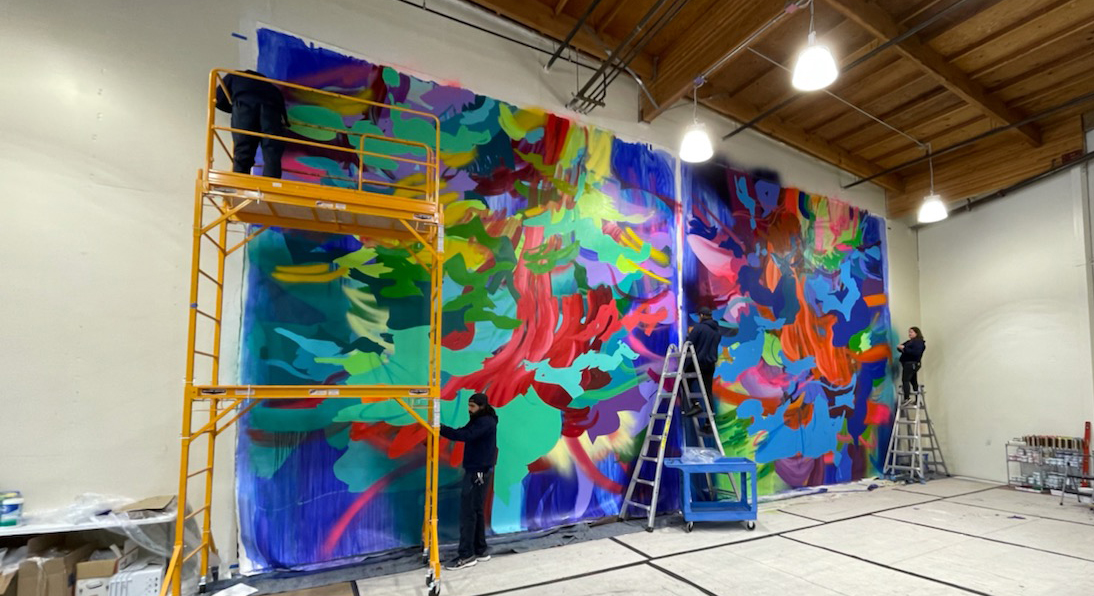
Our techs on the West Coast in San Francisco laying out a large artwork for viewing.