



Filter

Location
- Miami, USA
Job Type
- Road / Warehouse Based
Filter
Location
- New York, USA
Categories
- Notice
- Pinned
Tuesday 30th June 2026
Why White Glove Logistics Has Become Essential to Interior Design
by Joe Piotrowski, Director, Gander & White Miami
For decades, white glove logistics has been indispensable to the fine art world. Private and corporate collectors, galleries, museums, and auction houses understand that transporting, handling, and installing valuable works requires specialist expertise, meticulous planning, and close attention to detail. Today, those same expectations have become central to luxury interior design, where exceptional service often means seeing the potential problem before it reaches the client.
The distinction between art collections and residential interiors has become increasingly blurred. The most sophisticated homes are highly curated environments, where art, bespoke furnishings, custom finishes, and one-of-a-kind pieces work together to express a client’s personality and lifestyle. As custom fabrication and global sourcing play a larger role, the logistics behind these interiors have become every bit as important as the design itself.
The Evolution of Client Expectations
Luxury clients expect a seamless experience from concept through completion. That expectation now extends far beyond delivery, particularly as projects become more international, more bespoke, and more time-sensitive. Designers need partners who can inspect, store, manage, transport, and install furnishings with the same level of care that the art world has long demanded. Every item entering a warehouse must be examined; every piece arriving on site must be handled by professionals who understand both its value and its role within the overall scheme.
Design Projects Are More Complex Than Ever
In South Florida, where much of our work is focused on new construction, residential projects are becoming more ambitious. Homes often involve hundreds or even thousands of individual pieces arriving from manufacturers, artisans, and suppliers around the world. Longer lead times, international shipping considerations, and tighter installation windows mean that managing this volume of inventory now requires sophisticated coordination.
This is why many interior designers engage their logistics partner as early as possible — sometimes even a year before installation. Early involvement supports procurement planning, warehouse management, inventory tracking, and delivery scheduling throughout the project. With Gander & White’s roots in fine art handling and its experience supporting complex residential installations, that collaboration brings discipline, visibility, and care to high-end design projects.
Installation Is Where Vision Becomes Reality
Installation is one of the most underestimated phases of a project. It requires much more than moving furniture into a residence; it involves sequencing, coordination, problem-solving, and adaptability. Schedules may overlap with ongoing construction. Elevators may not be operational, access routes may change, and construction workers may still be working in critical areas. In these moments, flexibility becomes essential.
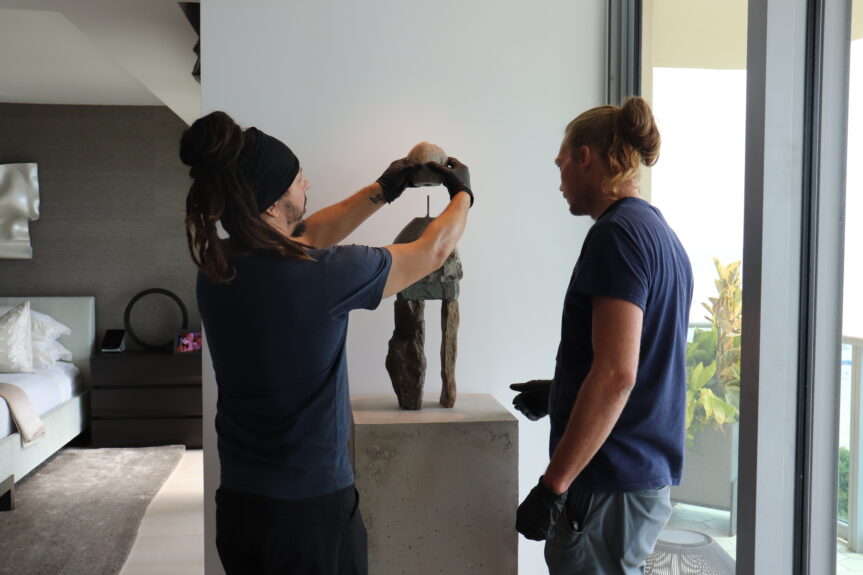
At Gander & White, our teams work with designers to anticipate obstacles, plan access, sequence deliveries, and move large or delicate pieces into complex spaces. Because we are accustomed to handling works and objects where condition, placement, and discretion are critical, we apply that same standard of care to the entire interior. The goal is simple: ensuring the designer’s vision is realized exactly as intended.
On one recent residential project, the challenge was not simply how to move a collection safely, but how to help the designer make confident decisions before anything was moved at all. Rather than repeatedly handling valuable works while the scheme was still being refined, we created full-scale vinyl replicas of the artworks. These could be placed, repositioned, and viewed throughout the residence, giving the designer and client a clear sense of how each piece would sit in the space without exposing the originals to unnecessary handling or risk.
It was a small intervention with a significant impact: fewer movements, lower risk, better decision-making, and a smoother experience for everyone involved. That kind of thinking is what distinguishes a logistics partner from a delivery provider. It is not only about completing a brief, but about anticipating what will make the designer’s process more precise, efficient, and reassuring for the client.
Protecting More Than Just Furniture
One misconception about logistics is that it is simply about transportation, when in reality it is primarily risk management. Open-and-inspect services, for example, allow designers to identify damage or manufacturing issues months before installation, creating time to reorder, repair, or adjust before deadlines are affected.
Experienced logistics providers also maintain networks of craftspeople, conservators, upholsterers, and repair specialists who can address issues quickly. For designers, that means a logistics partner can act not only as a handler or transporter, but as a practical problem-solving resource throughout the project.
Looking Ahead
As interiors designers grow ever more adventurous and ambitious with what they can achieve, logistics will become even more integrated into the design process. Designers increasingly expect real-time inventory visibility, dedicated project teams, and the ability to respond quickly to changing timelines. Technology will help with this, but experienced people will remain essential to delivering the judgment, adaptability, and care that clients expect.
My advice to interior designers is simple: involve your logistics partner early and treat them as a strategic collaborator. When logistics is considered from the outset, designers gain greater control, reduce risk, and create a smoother experience for everyone involved.
In today’s luxury interiors market, white glove logistics is no longer an afterthought. It is the invisible infrastructure behind exceptional interiors – protecting the designer’s vision, the client’s investment, and the experience of seeing a carefully conceived home come fully to life.